
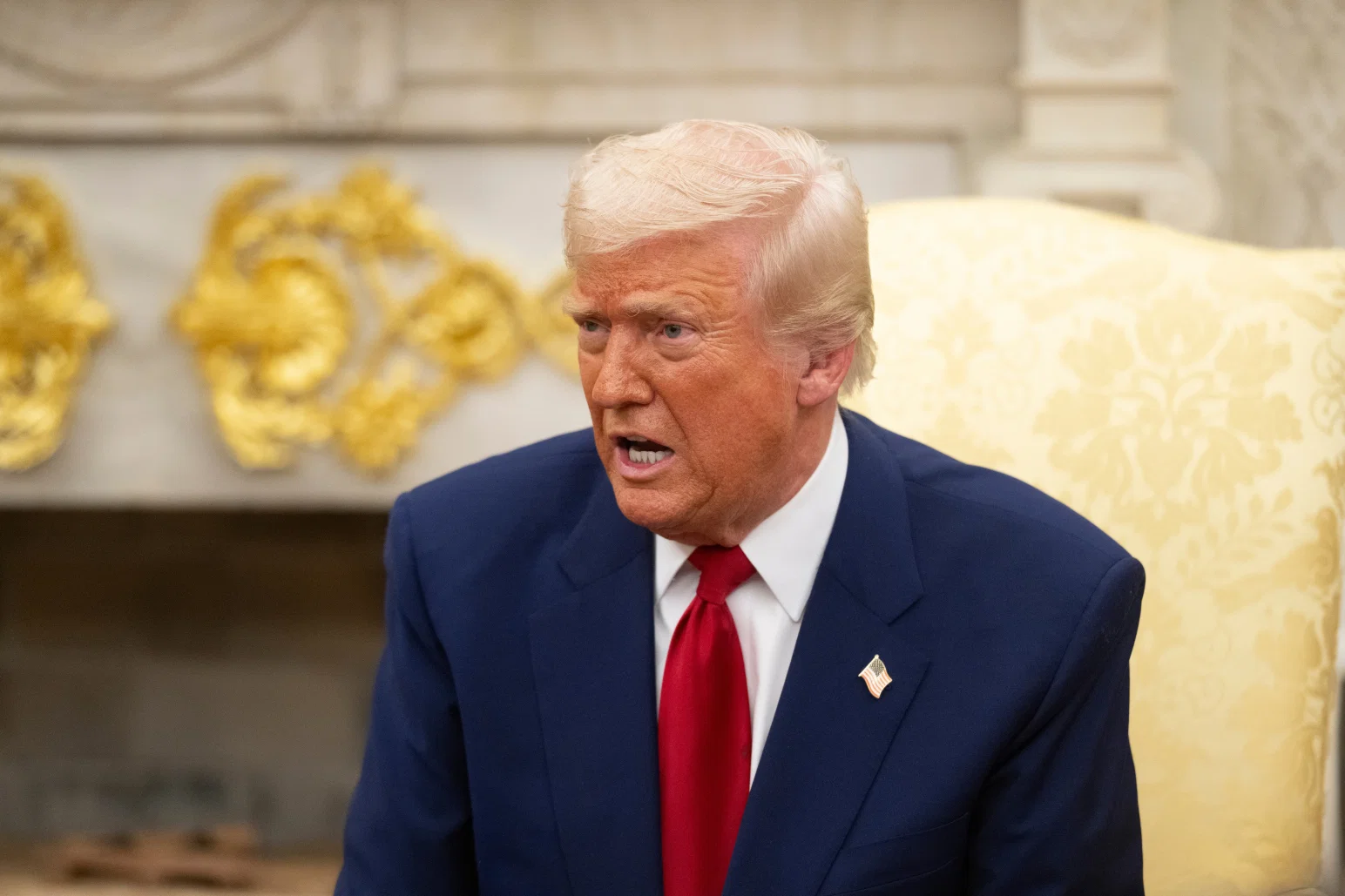
Donald Trump has never been shy about talking up his health.
He has described himself as exceptionally healthy, boasted about his cognitive-test scores, and repeatedly pointed to favorable medical assessments as evidence that concerns about his age and fitness are misplaced.
But now, a former White House physician is pushing back on the way those claims are being presented.
And the criticism isn’t necessarily that Trump is secretly sick.
It’s that a presidential health assessment should be measured by medical evidence not by the president’s own confidence in his condition.
That distinction matters more than ever for an 80-year-old president.
@cnn Dr. Jonathan Reiner is raising concerns about President Trump's health in a scathing New York Times op-ed titled "I Was Dick Cheney’s Cardiologist. Trump Has Not Looked Well, and We Should Know Why." Dr. Reiner tells Erin Burnett the president's pattern of falling asleep in public is 'most disturbing' but also points to the bruises on his hands and swollen legs as areas of concern.
♬ original sound – CNN
Trump Has Been Talking About His Health Again
Trump recently renewed his familiar health boasting, recounting how former White House physician Ronny Jackson allegedly praised his physical condition and calling attention to his performance on cognitive testing.
At one public appearance, Trump recalled Jackson saying he was healthier than other presidents the doctor had treated. The White House physician during Trump’s first term, Jackson served as medical adviser to both Barack Obama and Trump, though he did not serve as Joe Biden’s physician.
Trump has also repeatedly discussed cognitive tests he took while president, presenting strong scores as evidence of his mental fitness.
But there is an important catch.
A cognitive screening test is not the same thing as a comprehensive assessment of an individual’s overall neurological health.
A Cognitive Test Isn’t a Certificate of Perfect Health
The distinction has become increasingly important as Trump talks about his cognitive performance.
Tests such as the Montreal Cognitive Assessment, commonly known as the MoCA, are screening tools designed to identify possible cognitive impairment. They can be useful for detecting problems that warrant further evaluation, but they aren’t equivalent to a complete neurological examination or a comprehensive assessment of every aspect of cognitive function.
That means a perfect screening result can be reassuring.
It does not mean the test proves that every aspect of brain health is perfect.
That isn’t a criticism unique to Trump. It’s simply how medical screening works.
The Bigger Question Is Medical Transparency
Former White House physicians have argued that presidential health assessments should be substantially more comprehensive than the kind of abbreviated information voters sometimes receive.
Former White House physician Jeffrey Kuhlman, who served presidents including Bill Clinton, George W. Bush, and Barack Obama, recently told PBS that an 80-year-old president warrants particular attention to cardiovascular health, cancer screening, and possible neurodegenerative disease. He said he would want more extensive cardiovascular testing and more advanced cognitive assessment when evaluating a patient of Trump’s age.
That doesn’t amount to a diagnosis of Trump.
It highlights something more basic:
Older patients require different medical considerations than younger patients.
Trump Has Had Medical Evaluations. The Details Matter.
Trump’s administration has released medical information during his presidency.
A 2025 report from White House physician Sean Barbella described him as being in excellent physical and cognitive health and said his cholesterol was well controlled. The report also listed his medications and other medical information.
So it would be inaccurate to claim that the public has received no medical information about Trump.
The real dispute is over whether the information released is sufficiently detailed to support sweeping claims such as “perfect health” or whether more comprehensive testing and reporting should be made public.
That’s where medical experts disagree.
And That’s Where the “That’s a Mistake” Argument Comes In
The strongest criticism isn’t necessarily that Trump is lying.
It is that presidential health shouldn’t be reduced to a collection of favorable talking points.
A politician can say:
“I passed my test.”
A doctor can say:
“The screening result was normal.”
Neither statement necessarily answers every medically relevant question.
For an elderly president, voters may reasonably want to know about cardiovascular health, neurological function, medications, mobility, metabolic health, and other conditions that could affect the ability to perform demanding duties.
That is especially true because the presidency is not a normal job.
Trump Is the Oldest President Ever Inaugurated
Age is unavoidable in this discussion.
Trump was 78 when he began his second term and turned 80 during the presidency, making him the oldest person ever inaugurated as president of the United States.
That doesn’t mean age automatically means illness.
It does mean that age-related health risks become more relevant when evaluating fitness for an extraordinarily demanding position.
A former presidential physician told PBS that advanced age itself is the leading factor he would consider when evaluating a president of Trump’s age.
Ronny Jackson’s Old Health Claims Are Complicated by His Own Record
Trump’s frequent praise of Ronny Jackson also deserves context.
Jackson became famous during Trump’s first presidency for describing the president as having “incredibly good genes” and joking that he could live to 200 if he improved his diet.
Those comments generated considerable attention at the time.
But Jackson’s later career was also marked by controversy. A Pentagon inspector general investigation found that he had made inappropriate comments toward a female subordinate, violated alcohol-related policy during a presidential trip, and used prescription sleep medication in circumstances that raised concerns among colleagues. Jackson denied the allegations and described the investigation as politically motivated.
That history doesn’t automatically invalidate anything Jackson said about Trump.
But it does provide context for why his old superlatives shouldn’t be treated as definitive medical evidence.
The Public Is Left With a Difficult Balance
There are two competing principles here.
The first is privacy.
Presidents are people, and medical information is deeply personal.
The second is public accountability.
The president commands the U.S. military, controls enormous executive authority, and makes decisions with consequences around the world.
That creates a legitimate public interest in understanding whether the person holding the office is physically and cognitively capable of performing it.
Finding the right balance between those principles has always been difficult.
It’s especially difficult now because social media can turn every pause, stumble, bruise, or facial expression into a supposed medical diagnosis.
Internet Speculation Isn’t Medical Evidence Either
This is where the conversation can easily go off the rails.
A former physician questioning the completeness of a health assessment is one thing.
People online declaring that a photograph proves dementia, a stroke, or another neurological disorder is something else entirely.
There is currently no public medical evidence establishing that Trump has dementia based on the types of viral images and clips that circulate online.
Similarly, an optimistic medical statement doesn’t prove that every conceivable health concern has been ruled out.
Both extremes go beyond the available evidence.
What Voters Actually Need Is Better Information
The most useful debate isn’t:
“Is Trump secretly sick?”
It’s:
“What level of medical transparency should Americans expect from an 80-year-old president?”
That question can be answered without diagnosing anyone from afar.
A genuinely informative presidential medical report could provide voters with clearer information about:
- cardiovascular health
- neurological function
- cognitive screening
- medications
- relevant chronic conditions
- mobility and physical stamina
- doctors’ overall assessment of fitness for office
That would give the public something far more valuable than another boast about being “the healthiest.”
Trump Doesn’t Need to Prove He’s Superhuman
And perhaps that’s the strangest part of the entire controversy.
Presidential medicine isn’t supposed to establish that a president is invincible.
Nobody is.
The goal is to establish whether the person is fit to perform the job and whether there are medical conditions that could reasonably affect that ability.
Trump can be healthy for an 80-year-old without being “perfectly healthy.”
He can have normal cognitive screening without that test proving every aspect of brain function.
And he can have age-related medical issues without being incapable of serving as president.
Those realities aren’t contradictory.
The Health Debate Isn’t Going Away
Trump will probably continue talking about his health.
His supporters will continue pointing to medical reports that describe him positively.
Critics will continue scrutinizing his public appearances and calling for greater disclosure.
But the most credible path forward isn’t more speculation from either side.
It’s better evidence.
Because when the person in question is the commander in chief, Americans deserve something more substantial than presidential self-assessment or viral internet diagnosis.
They deserve the medical facts and enough of them to understand what those facts actually mean.