The internet loves a good “main character moment.” Unfortunately, real life doesn’t always cooperate.
A viral tweet has sparked renewed conversation about the “gay best friend” stereotype, emotional entitlement, and how people sometimes project expectations onto LGBTQ+ workers in public-facing roles whether they asked for it or not.
On X (formerly Twitter), writer Brendan Fraser Crane recounted a recent flight experience that quickly took off online.
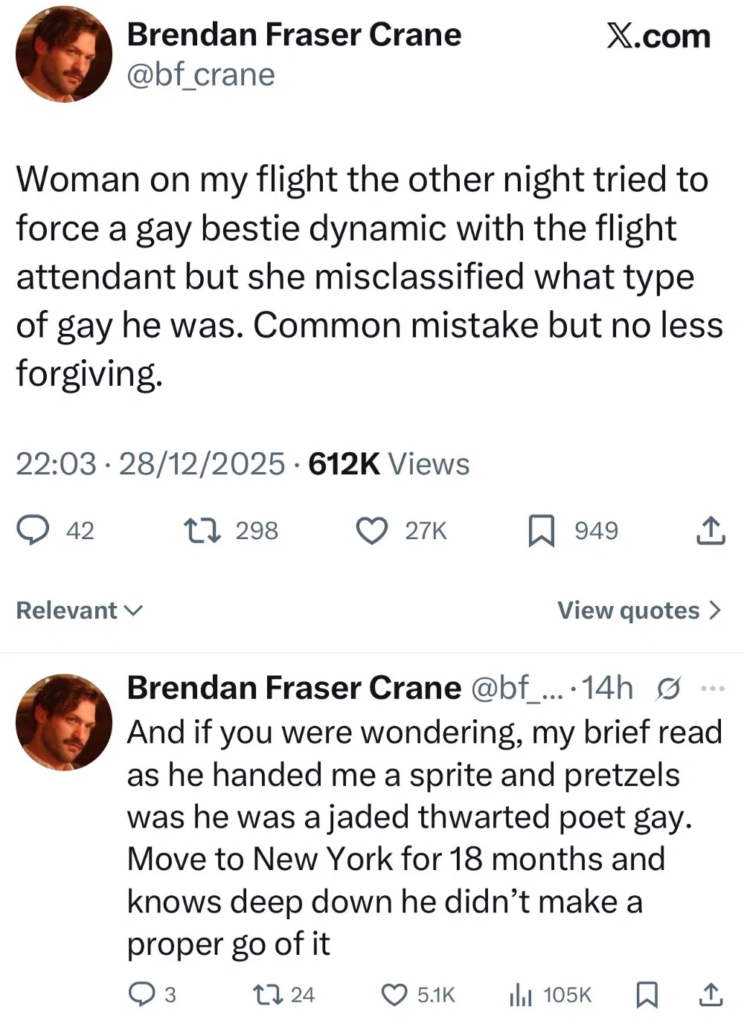
“Woman on my flight the other night tried to force a gay bestie dynamic with the flight attendant but she misclassified what type of gay he was. Common mistake but no less forgiving.”
Crane’s dry observation struck a nerve. His tweet racked up over 27,000 likes, with replies flooding in from queer users, hospitality workers, and anyone who has ever been emotionally conscripted into a stranger’s fantasy friendship.
You Don’t Choose the Gay Best Friend They Choose You
Crane didn’t stop there. He went on to offer his own tongue-in-cheek assessment of the flight attendant in question:
“And if you were wondering, my brief read as he handed me a Sprite and pretzels was he was a jaded thwarted poet gay. Move to New York for 18 months and knows deep down he didn’t make a proper go of it.”
The specificity alone earned applause.
But beyond the humor, the replies zeroed in on an important truth: queer people are not interchangeable archetypes.
Many users echoed a sentiment that’s long been understood within LGBTQ+ communities but often ignored outside them:
You don’t get to assign yourself a gay best friend.
Shared sexuality does not guarantee emotional labor.
Being friendly at work does not mean signing up for intimacy.
As one commenter succinctly put it:
“A wild social misread.”
The ‘Gay Best Friend’ Trope, Revisited
The “gay best friend” stereotype has a long, complicated history. Popularized in rom-coms and early 2000s pop culture, it frames queer men as:
Emotionally available
Fashionable
Non-threatening
Existing primarily to support straight women
While often portrayed as affectionate or flattering, the trope reduces real people into props. It flattens queer identity into something consumable, transactional, and crucially on demand.
What’s missing from that fantasy? Consent. Context. Humanity.
Woman on my flight the other night tried to force a gay bestie dynamic with the flight attendant but she misclassified what type of gay he was. Common mistake but no less forgiving.
Flight attendants, baristas, bartenders, retail workers these are all roles that require warmth, patience, and emotional regulation. Add queerness into the mix, and some customers begin to confuse professional politeness with personal availability.
That’s where things get uncomfortable.
Hospitality workers aren’t there to:
Validate your identity
Perform queerness for entertainment
Offer insider gossip or emotional bonding
They’re there to do their jobs often under pressure, scrutiny, and exhaustion.
Over-familiarity, especially when rooted in stereotypes or attempts to gain preferential treatment, doesn’t come off as cute. It comes off as invasive.
These FA gays. You have to approach them like a hippogriff in Harry Potter.
Part of why Crane’s tweet took off is because it captured something deeply relatable: the quiet irritation of being misread, boxed in, or expected to perform.
For queer people, especially those in service roles, this kind of interaction is common. It’s not malicious — but it is exhausting.
The joke lands because it exposes a truth: Not every queer person wants to be approachable, bubbly, or emotionally accessible — especially while working.
And that should be okay.
A Lesson Worth Remembering
The takeaway here isn’t “don’t be friendly.” It’s be respectful.
Friendly interactions are welcome. Kindness is appreciated. But assuming intimacy, projecting stereotypes, or forcing connection especially across a power dynamic is where things go sideways.
As many replies pointed out, judging someone based on a stereotype and trying to force them into a role is always a mistake.
That’s a lesson worth bearing in mind at cruising altitude and beyond.
Final Boarding Call
Queer people are not archetypes. Service workers are not side characters. And no one owes you a friendship just because you decided they fit a vibe.
Sometimes, a Sprite and pretzels are just a Sprite and pretzels.