
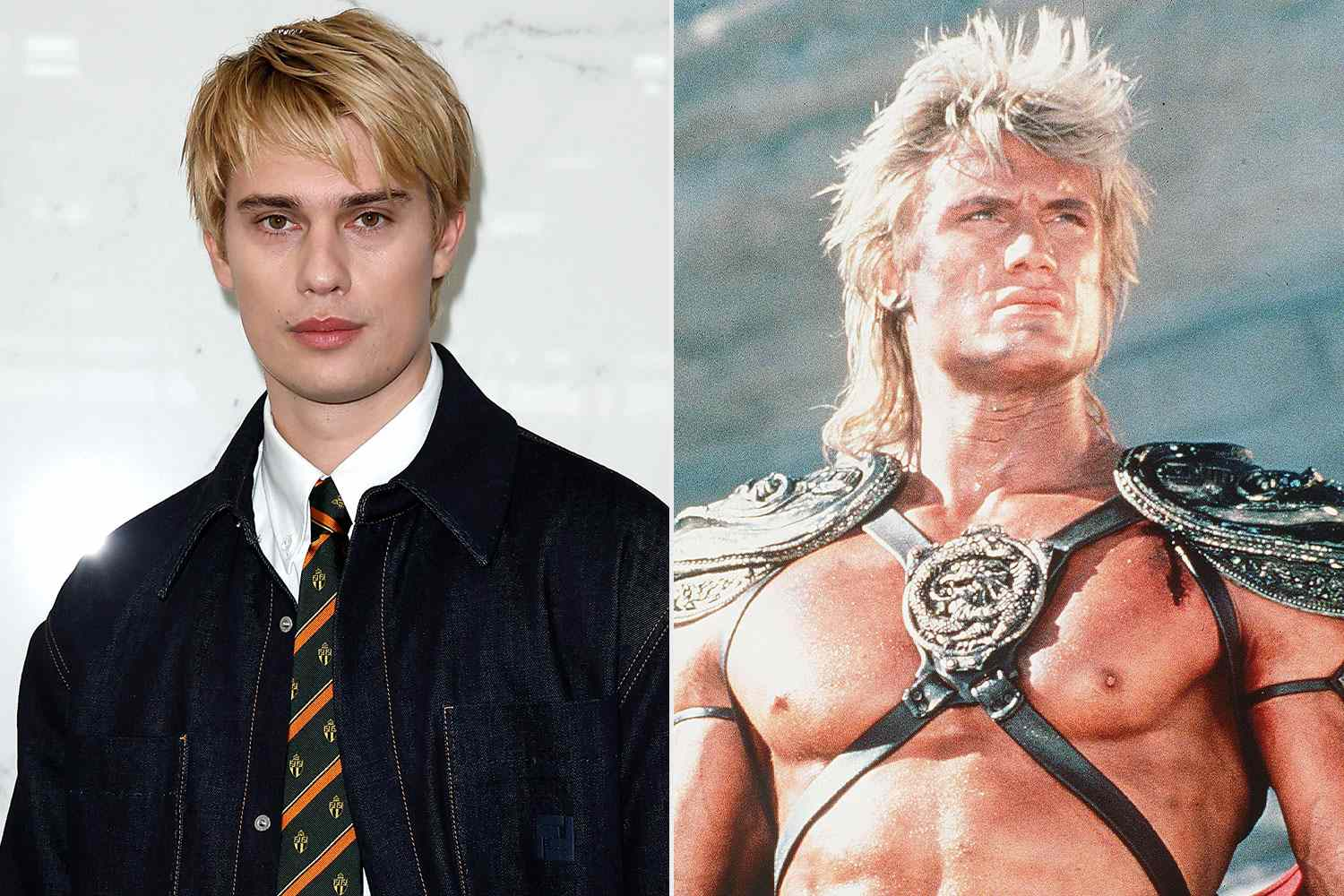
When Nicholas Galitzine found himself staring into the molded plastic eyes of his own He-Man action figure, the moment carried far more weight than simple celebrity merchandise. It represented the passing of a torch one loaded with four decades of pop culture history, cultural symbolism, and a legacy that far outgrew its original cartoon origins.
To understand whether Galitzine can truly fulfill the role of He-Man, it’s essential to look back at where the character came from, what he represented, and why he still matters today.
The Birth of He-Man and Masters of the Universe
He-Man was born not from storytelling ambition, but from marketing brilliance. In the early 1980s, Mattel sought to compete with the explosive popularity of Star Wars action figures. When a licensing deal fell through, the company decided to create its own fantasy-based toy line one that would prioritize physical power, bold aesthetics, and instant shelf appeal.
The result was Masters of the Universe, launched in 1982, with He-Man as its centerpiece. The animated series followed soon after, largely existing to support toy sales. Yet despite its commercial roots, the character took on a life far beyond his original purpose.
Nicholas Galitzine as He-Man in the trailer for 'Masters of the Universe'
— MEN (@MENin4K) January 22, 2026
OMG HE'S PERFECT… pic.twitter.com/HpaSxZE1H5
What He-Man Originally Represented
At his core, He-Man was a power fantasy. Prince Adam, the mild-mannered alter ego, transformed into the strongest man in the universe by raising the Power Sword and declaring, “By the power of Grayskull, I have the power.”
This transformation wasn’t subtle. He-Man’s exaggerated musculature, minimal armor, and primal strength symbolized an idealized version of masculinity one that was heroic, protective, and physically dominant. In the conservative climate of the 1980s, this hypermasculinity was framed as aspirational and morally righteous.
But there was also something unintentionally subversive about it.
The Queer Subtext That Refused to Stay Subtext
Over time, He-Man became an accidental queer icon. His near-nudity, dramatic poses, emotional intensity, and secret identity resonated deeply with queer audiences, particularly gay men who saw reflections of themselves in Adam’s dual life.
The show’s villains, allies, and aesthetics only added fuel to the fire. Characters like Skeletor, Fisto, and Man-At-Arms embodied camp, theatricality, and coded queerness long before mainstream media was ready to name it.
This legacy is so entrenched that He-Man’s queer associations now have academic discussions, fan essays, and even a dedicated Wikipedia section. What began as a toy line evolved into a cultural touchstone that helped shape identity, nostalgia, and self-discovery for generations.
Why He-Man Still Matters Today
He-Man’s endurance is remarkable precisely because the original cartoon was short-lived. What persisted instead was the imagery the toys, the physiques, the fantasy world of Eternia.
For many, He-Man represents a lost era of unapologetic imagination. For others, he symbolizes a personal awakening, a reclaiming of masculinity, or a camp icon ripe for reinterpretation. In a modern landscape increasingly open to fluidity and reinterpretation, He-Man feels strangely current again.
That context makes casting Nicholas Galitzine especially significant.
Nicholas Galitzine as the New He-Man
Galitzine is not the obvious choice one might expect from an 80s reboot. He doesn’t come from a background of traditional action franchises. Instead, he rose to prominence through emotionally driven roles, romantic leads, and performances that emphasize vulnerability as much as physicality.
This is precisely why his casting matters.
Modern audiences no longer want hollow power fantasies. They want depth. They want emotional stakes. They want characters who can carry both strength and sensitivity and Galitzine has already proven he can do that.
Can Galitzine Fulfill the Role of the Original He-Man?
The answer depends on how one defines “fulfill.”
If fulfillment means replicating the exact exaggerated masculinity of the 1980s version, then no modern actor should attempt that. That version belonged to a specific cultural moment.
If fulfillment means honoring He-Man’s symbolic power while evolving the character for a new generation, Galitzine is uniquely positioned to succeed.
He brings emotional intelligence to the role, an existing queer fanbase that understands He-Man’s layered legacy, and a willingness to embrace both sincerity and spectacle. His reaction to seeing his own action figure describing it as a childhood dream realized suggests genuine respect for the character rather than ironic distance.
Mattel’s Modern Approach to Legacy Characters
Mattel’s recent strategy indicates they understand nostalgia alone isn’t enough. Following the success of Barbie, the company has shown a willingness to interrogate, subvert, and modernize its properties rather than simply repackage them.
A He-Man film led by Galitzine suggests a version of the character that acknowledges his past while refusing to be trapped by it.
The Weight of the Sword, Then and Now
He-Man was never just a cartoon hero. He was a mirror reflecting fantasies, fears, and desires back at the audience. That mirror has changed shape over time, and Nicholas Galitzine now stands at its center.
Whether as a childhood icon, a queer symbol, or a modern cinematic hero, He-Man continues to evolve. And if staring into your own He-Man action figure doesn’t force you to reckon with legacy, expectation, and transformation nothing will.
The power of Grayskull, it seems, is in very capable hands.