A Gay Old Time: Queer Cinema, Survival, and Making It to the Next Level
As we finally say bon voyage to the sinking ship that was 2025, there’s something oddly comforting about revisiting a disaster movie where everything quite literally goes upside down.
Welcome back to A Gay Old Time, our ongoing queer film retrospective that looks at cinema through the lens of survival, resilience, camp, and coded identity. This week, as the calendar flips and the collective exhaustion sets in, we’re revisiting 1972’s The Poseidon Adventure a New Year’s Day survival epic that feels uncannily perfect for the moment we’re in.
The end of any year brings reflection, melancholy, and turbulence. The end of this year? That feeling has been dialed up to eleven. As we look back at the chaos, grief, wins, losses, and very public meltdowns that defined 2025, we also look forward cautiously toward what comes next. The New Year is where the old collides violently with the new, and few films visualize that collision better than a luxury liner capsized by a rogue wave.
At the very least, no matter how rough this year felt, the ship we were on didn’t flip completely upside down. Or… did it?
It’s a Disaster! (And That’s the Point)
Disaster films occupy a fascinating corner of cinema. They’re built around one of the most primal conflicts imaginable: humans versus nature. Earthquakes. Infernos. Tsunamis. Structural collapse. No clear villain, no easy scapegoat just people forced to adapt or perish.
For queer audiences, that theme resonates deeply.
These films rarely focus on conquest or dominance. Instead, they’re about community under pressure, survival through cooperation, and ordinary people discovering unexpected strength. That emotional backbone makes disaster movies quietly queer-coded, even when they don’t explicitly say so.
The 1970s marked the golden age of the genre. Kicked off by Airport (1970), the decade delivered a parade of spectacles: The Towering Inferno, Earthquake, and, towering above them all, The Poseidon Adventure. These films combined massive ensemble casts, practical effects, and melodrama with genuine emotional stakes and Hollywood rewarded them with box office gold and Oscar nominations alike.
All Aboard the S.S. Poseidon
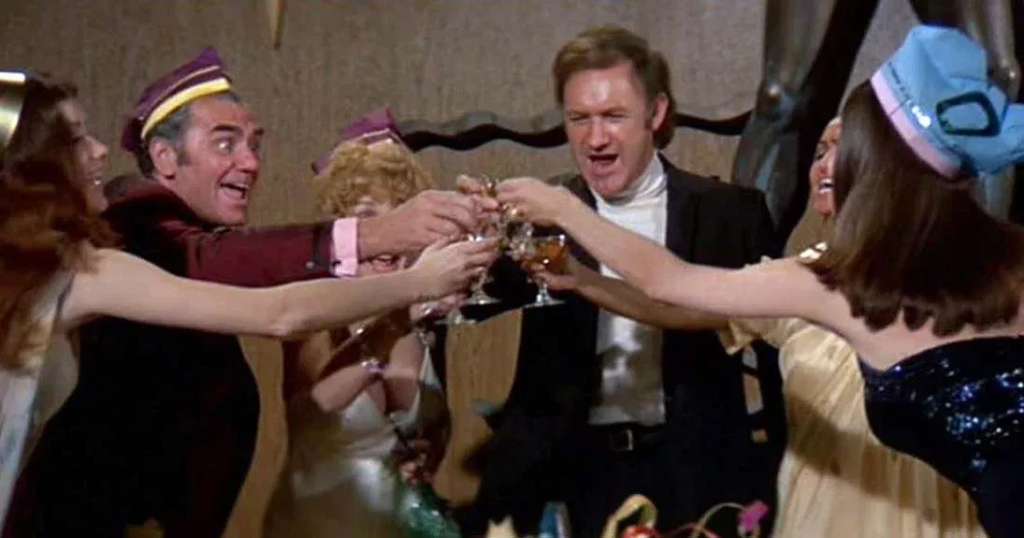
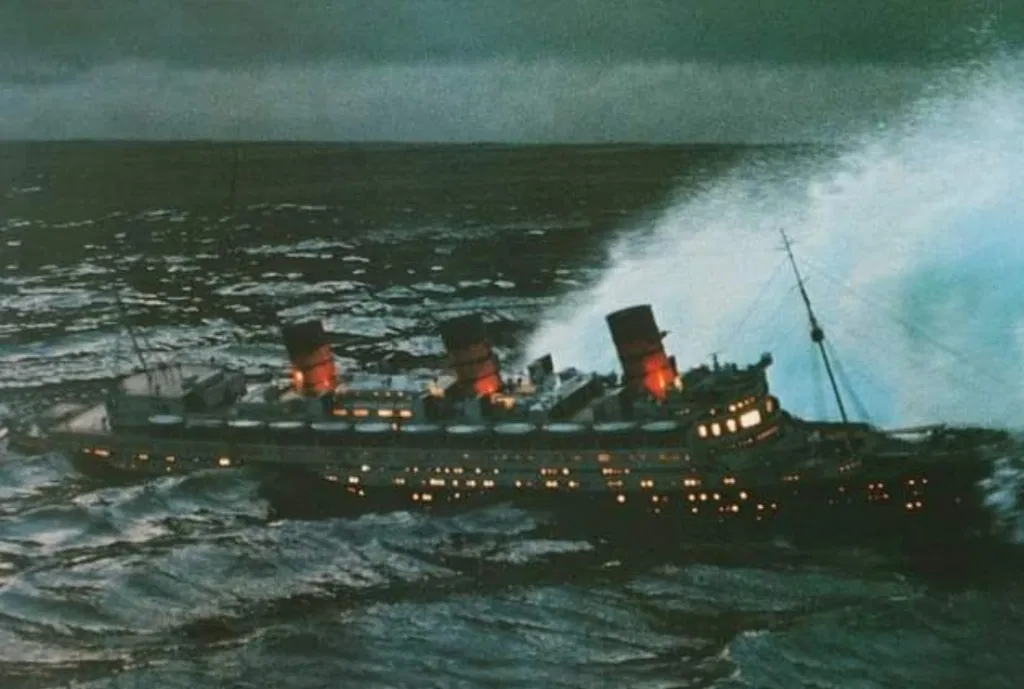
Directed by Ronald Neame, The Poseidon Adventure follows the luxury liner S.S. Poseidon on its final voyage from New York City to Athens, ringing in the New Year with champagne, sequins, and forced cheer.
Then disaster strikes.
An undersea earthquake triggers a colossal wave that flips the ship completely upside down. Suddenly, ceilings become floors, chandeliers become deadly obstacles, and survival depends on thinking against gravity.
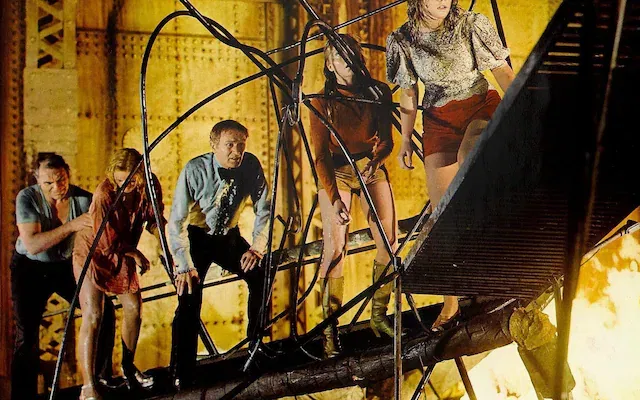
A small group of passengers band together to escape through what is now the ship’s highest point — the galley door as water floods in and time runs out.
The ensemble includes:
- A conflicted reverend questioning his faith (Gene Hackman)
- A gruff retired detective and his glamorous wife (Ernest Borgnine & Stella Stevens)
- An elderly Jewish couple grappling with physical limitations (Jack Albertson & Shelley Winters)
- A teenage girl protecting her younger brother
- A soft-spoken waiter (played by the late, closeted Roddy McDowall)
- A cruise singer with starry ambition
- And James Martin, a “lifelong bachelor” portrayed by Red Buttons flamboyant, lonely, and unmistakably queer-coded
The film unfolds almost like a video game: each escape route is a new “level,” complete with physical challenges and emotional sacrifices. Climbing through Christmas trees. Crawling through air ducts. Swimming through flooded corridors. Each obstacle strips the characters down to their essence.
Queer Coding, Camp, and Quiet Representation
By modern standards, The Poseidon Adventure isn’t progressive. It wasn’t trying to be. But within the limitations of early ’70s Hollywood, it still manages something quietly meaningful.
Red Buttons’ James Martin is never explicitly labeled, but the subtext is loud. His wardrobe, mannerisms, and social isolation tell a story audiences especially queer ones immediately recognize. Importantly, the film treats him with empathy rather than cruelty. He’s not a joke. He’s not punished for who he is. His arc centers on usefulness, courage, and connection.
That matters.
So does Roddy McDowall’s presence another performer whose real-life queerness existed under strict studio-era silence. Watching these characters navigate catastrophe alongside everyone else reinforces a powerful idea: queer people have always been there, even when the stories couldn’t say our names out loud.
All Hands on Deck
The emotional heart of the film belongs to Gene Hackman’s Reverend Frank Scott and Shelley Winters’ Belle Rosen.
Hackman’s reverend struggles with leadership and faith, openly questioning God as he watches death unfold around him a radical choice for the time. Winters, meanwhile, delivers a performance so grounded and human that it earned her an Academy Award nomination. Belle fears being a burden due to her age and body, only to prove herself indispensable when it matters most.
It’s a reminder that heroism doesn’t look one way. Strength shows up in unexpected forms — a message queer audiences know well.
Here’s to Smooth(er) Sailing in 2026
Disaster movies might seem like unlikely comfort viewing, but they offer something essential: perspective.
They remind us that survival isn’t about perfection. It’s about adaptation. About trusting others. About pushing forward even when the world is literally upside down.
Living through 2025 often felt like being trapped aboard a sinking ship — institutions failing, certainties collapsing, and exhaustion setting in deep. But we’re still here. We made it to the next level. Maybe not unscathed, but alive.
And as The Poseidon Adventure shows us, sometimes survival itself is the victory.
Happy New Year. 🏳️🌈
1972’s The Poseidon Adventure is currently streaming on Amazon Prime Video and available for rental or purchase via Amazon and Apple TV.