It was a freezing December evening when Javi (not his real name) stepped off a plane at O’Hare International Airport. The 30-year-old from El Salvador had fled his home country after receiving death threats not from strangers, but from his own uncle, a police officer who vowed to kill him for being gay.
“He said, ‘I’m gonna kill you, because in my family, it’s not allowed to have a fa**ot,’” Javi recalled.
In El Salvador, anti-LBGTQ+ persecution isn’t isolated; it’s systemic. Under President Nayib Bukele’s authoritarian rule, police and military forces have been empowered to detain and harass civilians with impunity. Once hailed as a modern reformer, Bukele now openly attacks “gender ideology” and erases LGBTQ+ protections.
Javi’s only path to survival was escape.
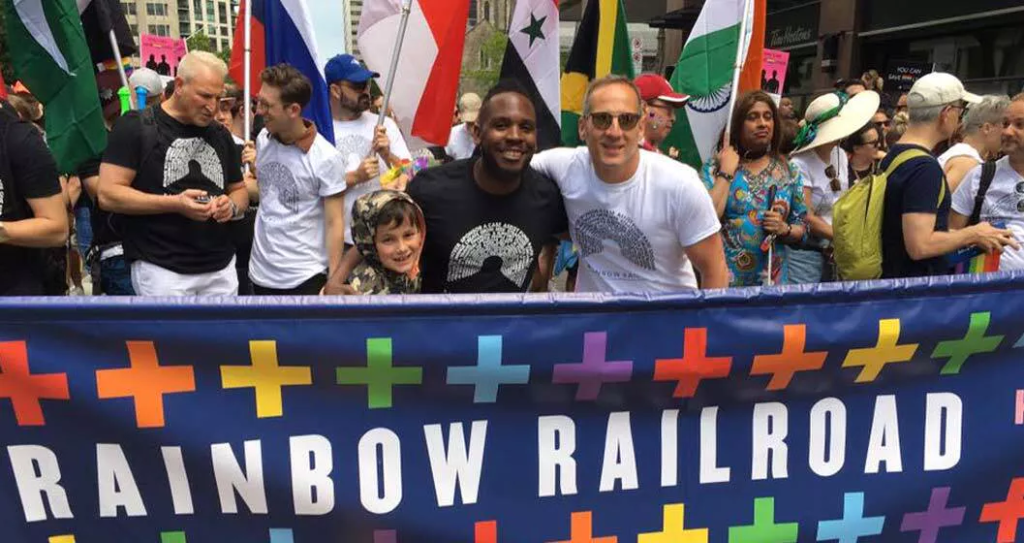
Through Rainbow Railroad, a nonprofit that helps LGBTQ+ people flee state-sponsored violence, he secured passage to the United States, a place once synonymous with safety and freedom. But in the shadow of a second Trump presidency, that promise now feels uncertain.
Rainbow Railroad: A Lifeline for Queer Asylum Seekers
Founded in 2006, Rainbow Railroad takes its name from the Underground Railroad — the 19th-century network that helped enslaved people reach freedom. Today, it serves a similar mission for LGBTQ+ individuals fleeing persecution worldwide.
The organization has helped nearly 15,000 queer refugees relocate to safer countries, including over 300 in 2024 alone. Many are escaping violent crackdowns in countries like Uganda, Jamaica, and El Salvador, where being openly queer can mean imprisonment or death.
“People are forcibly displaced not because they want to leave, but because of who they are and who they love,” says Latoya Nugent, a Jamaican activist and engagement director for Rainbow Railroad.
The Human Cost of Anti-Immigrant Policy
For advocates like Nugent, the stakes couldn’t be higher. On his first day in office, Donald Trump suspended refugee admissions into the United States. Later, he slashed the refugee cap from 125,000 under Biden to just 7,500 for 2025, the lowest in modern history.
Even more alarming, Trump’s new refugee priority list heavily favors white South Africans, effectively excluding people of color, queer refugees, and those fleeing the Global South.
“It’s a mindset steeped in xenophobia,” Nugent says. “The narrative that refugees are freeloaders or criminals is false. They contribute. They rebuild. They give back.”
How the Welcome Corps Changed and Saved Lives
Before Trump dismantled it, Welcome Corps, a State Department initiative, allowed small volunteer groups to sponsor refugees for three months and help them integrate into U.S. communities.
Rainbow Railroad became one of the program’s key partners, and Javi was one of its first arrivals.
“I didn’t even know I was flying to Chicago until I got to the airport,” he said. “When I saw two people waiting for me, I realized these are from Rainbow Railroad.”
Those two people were part of Javi’s Community of Care, five LGBTQ+ sponsors led by Bruce Koff, a therapist and longtime Rainbow Railroad board member.
“We wanted to make sure he felt safe, supported, and seen,” Koff explained. “At dinner, I told him, ‘You have five mothers now — cinco madres.’ And he laughed. That moment broke the ice.”
With their help, Javi secured housing, work authorization, a social security number, and health care. Within months, he was working two jobs and later landed a nonprofit position serving Chicago’s Latinx community.
“He’s exactly the kind of person America should welcome,” Koff says. “He contributes, he cares, and he wants to pay it forward.”
Living with Fear in the Land of the Free
Yet even with legal refugee status, Javi’s safety is not guaranteed. Under Trump’s renewed immigration agenda, LGBTQ+ asylum seekers could once again face detention or deportation.
“The only caveat,” Koff notes, “is the times we live in. Even with papers, we don’t know what risks Javi may face.”
For many refugees, the fear of losing legal protection in a hostile political climate is almost as traumatic as what they fled.
A Chain of Kindness: Paying It Forward
Javi’s story isn’t unique. Rainbow Railroad has helped refugees who, after rebuilding their lives, immediately turned to help others.
One relocated refugee in Washington, D.C., stunned by the sight of married men holding hands vowed to start his own support circle for new arrivals. After getting his first paycheck in San Francisco, he donated part of it to an LGBTQ+ youth organization.
“They build community so quickly,” Nugent says. “When they finally find safety, they feel human again and they show up in the world differently.”
The Fight for Refugee Rights Isn’t Over
With the Welcome Corps dismantled and refugee admissions drastically reduced, Rainbow Railroad is adapting. The organization recently launched a Community Access Fund to provide direct financial support to queer asylum seekers already in the U.S., and a Rainbow Housing Drive to match newcomers with volunteer hosts.
But the need is far greater than the resources available.
In 2024 alone, Rainbow Railroad received 13,402 requests for help and could only assist 5,886. The organization warns that with fewer legal pathways for relocation, countless LGBTQ+ people could be trapped in violent regimes with no way out.
“This isn’t charity,” Nugent emphasizes. “It’s a moral obligation.”
Hope in the Midst of Uncertainty
Despite the challenges, Javi remains hopeful. He volunteers with other queer migrants, sharing his story with those still trapped abroad, including a young gay man in Uganda considering escape.
“It’s great to share my experience,” Javi says. “In countries like that, it’s illegal to be gay. People live in fear. I can help them see there’s a way out.”
For Koff, seeing Javi thrive is proof of what compassion can accomplish.
“To witness someone go from fear to stability it’s magical,” Koff says. “It reminds us that no matter how dark the times, there’s always a way to help.”