
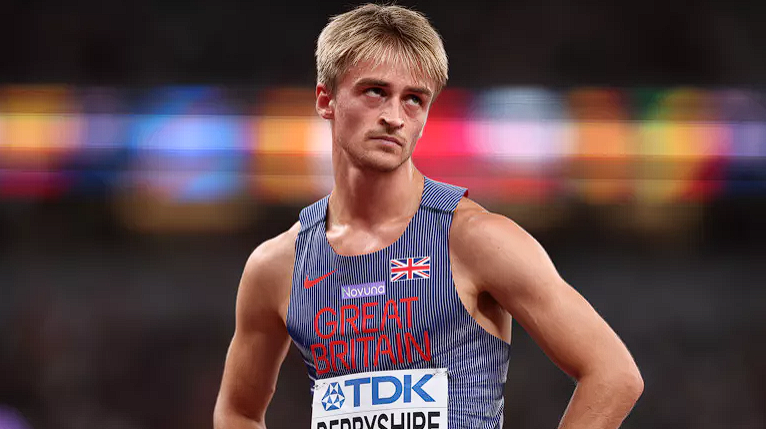
2 of the Fastest Men on Earth Are Gay and They’re Breaking More Than Finish Lines
Trey Cunningham and Seamus Derbyshire are two of the fastest hurdlers in the world. But beyond speed, what they share is something deeper: visibility, authenticity, and rewriting what it means to compete at the highest level while being openly gay.
Who They Are & What Makes Them Fast
Seamus Derbyshire (Britain, 400m hurdles) has been emerging as one of the sport’s rising stars. He attended Loughborough University and runs for City of Stoke AC. Derbyshire has posted fast times this year, including a personal best of 48.42 seconds in Geneva, just inside the qualifying standard for the World Championships. He’s now among the top British hurdlers, with major national and international experience.
Trey Cunningham (USA, 110m hurdles) has also had a breakout year. After publicly coming out in 2024, he’s run some of his best races yet. He took silver at the 2022 World Championships, competed in Olympic Trials in 2024, and continues racking up wins and strong performances.
Coming Out, Showing Up
What separates Cunningham and Derbyshire isn’t just what they do on the track, but who they allow themselves to be off it:
- Seamus Derbyshire has spoken openly about how embracing his identity—flamboyance, queerness helped him mentally and athletically. He’s one of a tiny handful of publicly out gay or bi men competing at major global track meets. That authenticity has given him clarity, confidence, and, as he says, “one person I can inspire.”
- Trey Cunningham’s decision to come out has been transformative. He describes wanting to be “100% authentic, transparent, and not holding back any part of me.” For him, the coming out wasn’t just a moment—it’s shaped his mindset, training, and how he views competition.
Why Their Stories Matter
These athletes aren’t just running hurdles. They’re jumping over broader social obstacles too:
- Representation in Elite Men’s Sports
Queer visibility among male athletes at top levels remains rare. Both Cunningham and Derbyshire challenge a long-standing stereotype that being openly gay conflicts with athletic dominance. Their presence makes a difference for younger LGBTQ+ athletes who often don’t see someone like them. - Mental Health & Performance
Derbyshire has discussed anxiety and the toll of hiding his identity. Cunningham has described burnout and the pressure to perform while keeping parts of himself private. Both suggest that authenticity isn’t just emotionally freeing—it can improve athletic performance. - Shifting the Narrative
When these athletes compete openly, they help shift public perception. As they collect wins, medals, and public respect without apologies, they prove that being queer is not a weakness in sport—it can be a strength.
Recent Achievements & What They’re Running Towards
- Derbyshire ran 49.20 seconds in his heat at the 2025 World Athletics Championships in Tokyo. While he didn’t advance, he expressed pride in how far he’s come. He finished 27th out of 44 overall.
- Cunningham swept the short hurdle events at the Miami Grand Slam Track meet. He’s also set personal bests in both hurdles (110mH) and sprints (100m), indicating he’s pushing his limits.
They’re both aiming high for future competitions—Derbyshire in international meets for Britain, Cunningham eyeing the 2028 Olympic Games.
The Cultural & Emotional Impact
- For many queer youth, seeing someone like Derbyshire or Cunningham is validating. It’s one thing to admire athletic prowess; it’s another to see someone living openly who blends masculinity, queerness, and skill.
- Their authenticity intersects with fashion, social media, and personality. Derbyshire has talked about pop culture icons like Kylie Minogue and Gwen Stefani as inspiration. These influences show how queer culture flows into sports.
- There are still challenges: homophobia, expectations to conform, and internal pressures. Neither of these athletes is immune to scrutiny or criticism. The emotional labor of being visible is real.
What to Watch For :
- How Cunningham and Derbyshire perform in upcoming major meets (World Championships, Olympics), without any filters.
- The visibility factor: will media coverage amplify their identities and create space for others?
- Whether their success opens room for more openly queer male athletes in track and field and other “hypermasculine” sports.
- Potential advocacy: mental health, identity acceptance, sports culture reform, whether they use their platforms for broader change.
Final Thoughts
Yes, they are fast. But what makes Trey Cunningham and Seamus Derbyshire especially powerful isn’t just speed. It’s boldness. It’s living truthfully. It’s showing up.
In a world where many queer athletes hide or downplay parts of themselves, these two are saying: put all of me on the start line. Run with it. Let them see.